
Checking Criminal History in Wichita County
Begin with the Wichita County Judicial Records Search when the goal is to find a filed felony or Class A or B misdemeanor. Have the full name, a rough birth date, spelling variants, and a cause number when one is known. The District Clerk holds felony records. The County Clerk holds County Court at Law misdemeanor files. Fine-only cases can remain with a municipal or justice court, so a blank county result may point to the wrong court level rather than the lack of a record.
A complete Wichita County criminal record check uses more than the court index. Jail Data answers who is in county custody now or was booked recently. The police agency supplies its own incident or arrest report. Texas DPS then provides public conviction and deferred-adjudication information that state law permits it to release. For a person's own identity dispute, fingerprints give a stronger match than a name.
- Search the county judicial index and choose the court level that fits the alleged offense.
- Try the exact name, useful variants, and the cause number if available.
- Read each charge-level disposition instead of relying on the case status alone.
- Compare the court entry with WCSO Jail Data and the arresting agency's report.
- Ask the proper clerk for copies, or use DPS fingerprints to review and challenge your own state record.
Four Wichita County Record Counters
A Wichita Falls arrest can leave records at four separate counters. Wichita Falls Police keeps the offense and arrest narrative. WCSO creates the booking and custody entry at the Law Enforcement Center. A county clerk receives any filed felony or higher misdemeanor. Wichita Falls Municipal Court keeps fine-only city charges. Burkburnett and Iowa Park add their own police and municipal records to the same countywide split.
| Record sought | Wichita County custodian | Best channel |
|---|---|---|
| Felony case | District Clerk | Judicial search or Room 108 |
| Class A/B misdemeanor | County Clerk | County court index or clerk |
| Booking and custody | Wichita County Sheriff | Jail Data or WCSO request |
| Police narrative | Creating police agency | Agency records unit or written PIA request |
General county requests go to the Criminal District Attorney's Civil Division, but Wichita County expressly routes judicial records to the clerks and city police reports back to the city that made them. That routing rule saves time and keeps a public-information request from landing at an office that cannot fulfill it.
The statewide re:SearchTX service adds another court-search channel when a participating court and the user's access level make a record available.
Try Wichita County's own judicial link first, then use the clerk when either online system lacks an older file or needed document.
Texas Official Background Checks
The Texas Department of Public Safety Crime Records Division holds the state criminal-history repository. Its Criminal History Name Search offers public conviction and deferred-adjudication information that DPS may disseminate. One search costs one credit, currently priced at $1. The system broadens its match logic, and opening several matching rap sheets from that search does not consume more credits. A name result is still not biometric proof that two records concern the same person.
For self-review, DPS directs the subject to a fingerprint-based personal record review. Contact the Access and Dissemination Bureau at 512-424-2474, option 2, for the right process. Electronic fingerprint appointments use IdentoGO when the supplied service code calls for it. Never guess a service code. The FBI Identity History Summary is a separate subject-only federal route and does not replace Wichita County court files.
The official IdentoGO scheduler shows the enrollment entry used for Texas fingerprint services.
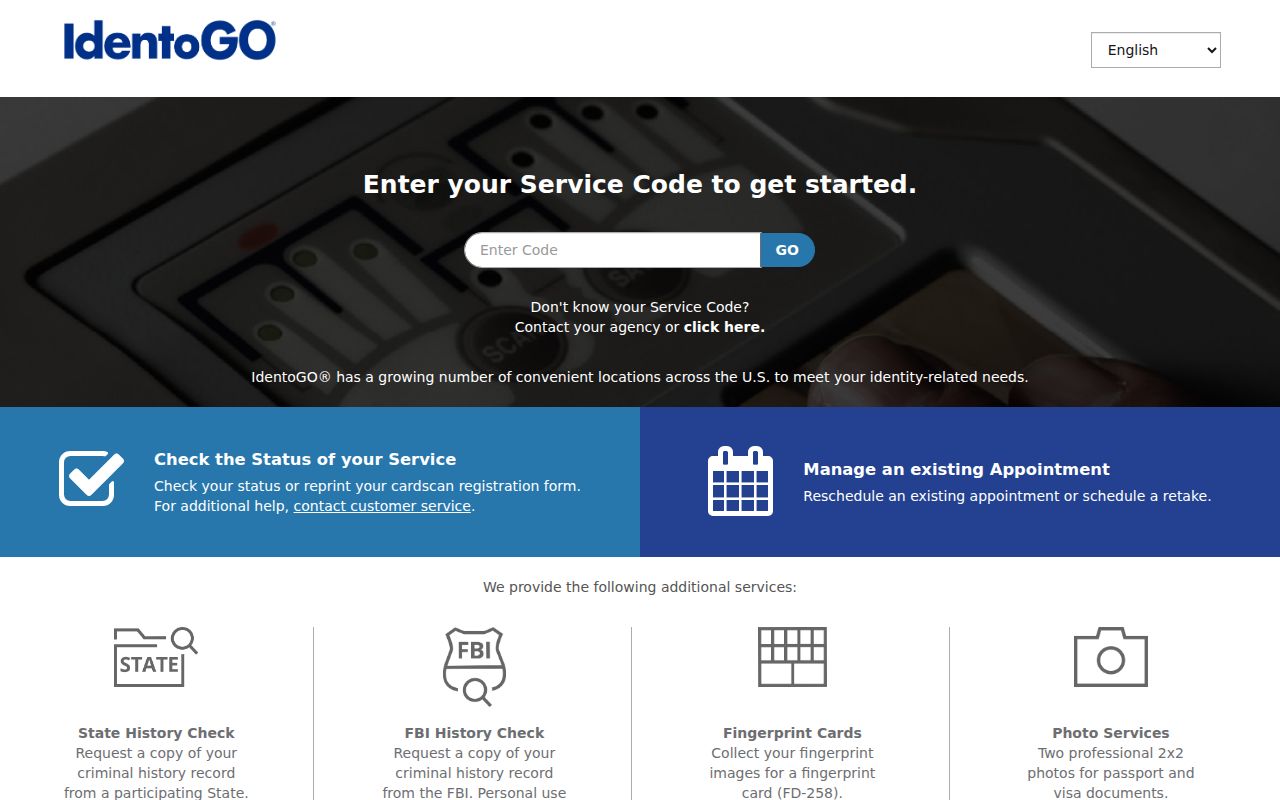
The scheduler should be searched by ZIP only after DPS provides the correct service code, because the research did not confirm a permanent public walk-in site inside Wichita County.
The $1 Texas DPS Record Search
DPS first tries a narrow match, then tests the last and first names without the middle name and can compare the name with the birth month and day. Full date-of-birth data helps narrow common names. Hyphenated names may need each component tried separately. The search also requires acceptance of its caveat before a credit is used.
| Field | Use | Search note |
|---|---|---|
| Last name | Required | Try components of a hyphenated name |
| First name | Required | Use the exact known spelling |
| Middle name | Optional | DPS also tests without it |
| Birth date | Match aid | Full date narrows the result set |
The DPS public history interface explains the credit and matching rules.
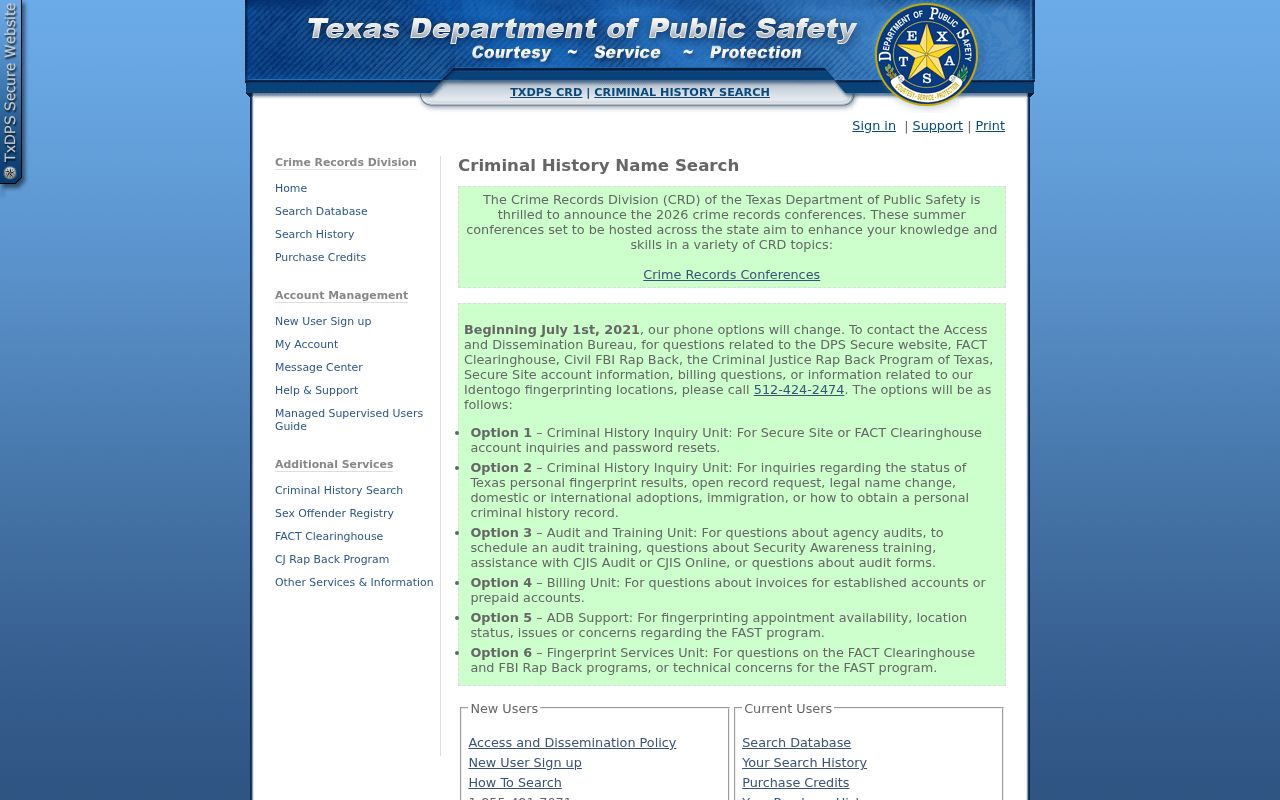
Use the result as a lead, then compare it with the local docket and a fingerprint review when identity or completeness matters.
Criminal Record Types
Each Wichita County record type answers a different question. An incident report describes what an officer saw or was told. An arrest record states the basis and time of an arrest. WCSO's booking file follows custody, bond, charges, and release. The prosecutor and court create the charging instrument and case file, while DPS links fingerprint-supported arrest cycles to outcomes reported by courts.
Warrants may sit with district, county, municipal, or justice courts. Community-supervision status is best checked through the judgment and Wichita County Adult Probation. TDCJ handles parole and state prison custody. The Texas Public Sex Offender Registry is a separate public-safety record, not proof of a new crime.
- Arrest and booking records: agency allegations and WCSO custody data, not findings of guilt.
- Criminal court files: filed charges, docket events, pleas, orders, disposition, and sentence.
- DPS history: public state entries tied to reported arrest cycles and outcomes.
- Warrants: court orders that may require checks with more than one clerk.
- Supervision and registry records: distinct court, TDCJ, and DPS sources with different access limits.
Wichita County Jail Data Means Custody
The official Jail Data launch is the right first stop for current or recent county custody. A public booking entry may show a booking number, booking time, arresting agency, initial charge, warrant or cause number, bond, location, status, and release. It should not be described as a conviction. The prosecutor can reject or change a charge, and the court later records the legal result.
If a name is absent, call WCSO at 940-766-8170 or submit a focused request for sheriff-created booking information. A transfer also matters. State custody belongs in the TDCJ Inmate Information Search, while federal custody belongs in the Bureau of Prisons locator. VINELink can provide notice where supported, but it is not the official case record.
Texas maintains a separate TDCJ Inmate Information Search for state prisoners.
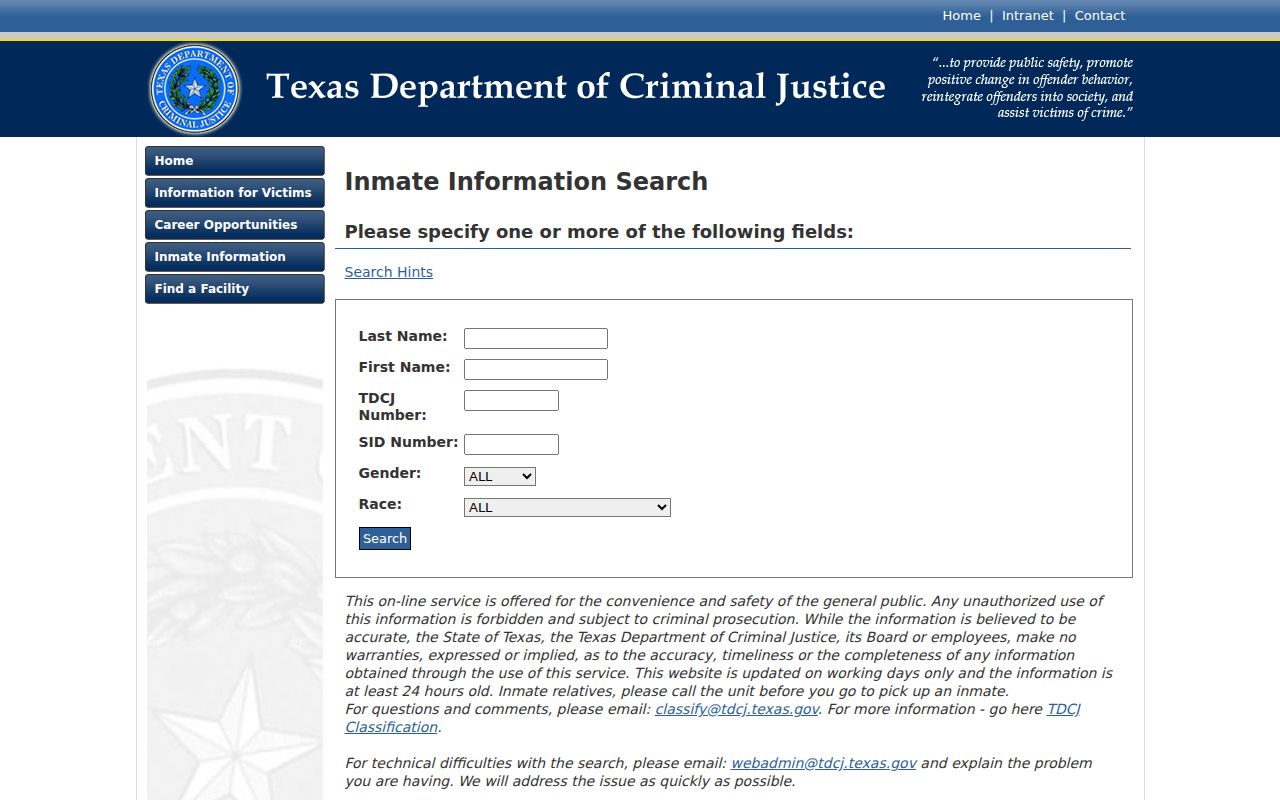
The state locator prevents the common mistake of treating Iowa Park's Allred Unit as part of the Wichita County jail.
Inside a Wichita County Criminal Record
A Wichita County court file is organized around a cause number, court, defendant, attorneys, filings, settings, orders, and a financial ledger. A DPS rap sheet instead starts with identity data and fingerprint-linked arrest cycles. A jail file groups the same event around custody. Reading the source label first prevents a booking charge from being mistaken for the charge a prosecutor filed.
| Name & Identifiers | Legal name, aliases, birth data allowed for display, and record or cause numbers. |
|---|---|
| Arrest / Booking Data | Agency, date, intake charges, bond, booking number, and custody status. |
| Charges & Statutes | Filed offense, legal class, count, and statute citation. |
| Disposition | Outcome for each count, such as conviction, dismissal, acquittal, or deferred adjudication. |
| Sentence | Confinement, community supervision, fine, costs, and other judgment terms. |
| Custody / Supervision Status | County jail, TDCJ, release, probation, or parole information when public. |
The disposition field gives the clearest answer to what happened. One cause can contain both dismissed and convicted counts, so read each charge line before using the judgment or sentence to describe the result.
Wichita County Cases Back to 1882
The District Clerk says its permanent felony records reach 1882. That depth makes the courthouse counter useful for genealogy and historic Wichita County criminal case research when a modern online index is not enough. Bring the person's name, an estimated year, and any cause number. The clerk charges $5 in advance for a name search, while ordinary copies are $1 per page and the criminal-copy guidance describes certified copies as $5 per document.
Archived does not mean unrestricted. Juvenile material, sealed or expunged files, victim identifiers, protected addresses, and confidential data can remain unavailable or redacted. Ask for a cost estimate before ordering a large file, and remember that the clerk cannot provide legal advice. The useful question is which document is needed: an indictment states the filed accusation, a docket lists case events, and the judgment records the outcome and sentence.
- Cause number
- The court's unique identifier for the case.
- Docket
- The dated register of filings, hearings, and orders.
- Disposition
- The outcome attached to a charge or count.
- True bill
- A grand jury's approval of an indictment.
Public Access Laws in Texas
The Texas Public Information Act provides access to government information unless another law makes it confidential or an exception applies. Yet court files are judicial records, so Wichita County directs them to the clerks rather than the ordinary county PIA desk. Law-enforcement information may also be withheld during specified investigative or prosecutorial conditions, while basic arrest information receives different treatment.
Key statutes and rules:
Government Code §552.021 makes public information available during normal business hours unless law limits access.
Government Code §552.108 addresses specified law-enforcement and prosecution records.
Government Code §§411.083 and 411.135 govern DPS history confidentiality and public conviction access.
Rule 76a and Texas judiciary policy place judicial-record access outside the ordinary PIA route.
Code of Criminal Procedure Chapter 55A governs expunction from January 1, 2025.
Wichita County Warrant Fallbacks
No single public list should be treated as a complete Wichita County warrant search. A warrant can arise in district court, County Court at Law, a municipal court, or a justice court. Check the case docket, call the issuing clerk, and contact WCSO. Sealed warrants and juvenile matters will not be open, and a fine-only municipal capias may not appear in the county felony index.
Wichita Falls Municipal Court warns that a missed appearance, setting, or deadline can produce a warrant and a $50 warrant fee. A qualifying delinquent citation sent to collections receives a 30 percent collection fee. A person resolving their own warrant should call 940-761-7880 to confirm the issuing court, citation or cause number, bond type, payment method, and whether a judge's setting is required. Do not walk into an agency based on a web result alone.
Warrant check flow: Case docket › Issuing clerk › WCSO confirmation › Court-approved resolution.
Sealed, Expunged, and Restricted Records
Juvenile records follow special confidentiality rules. Victim names, child information, Social Security numbers, account data, driver-license data, and protected addresses may be removed from public Wichita County copies. A redaction does not mean the record never existed. It means the custodian applied a legal access limit to some or all of the material.
Texas expunction under Code of Criminal Procedure Chapter 55A is the stronger removal or destruction remedy for a qualifying event. Eligibility depends on the precise arrest and outcome. Acquittals, actual innocence, and some dismissed or no-billed matters can qualify when all conditions are met. A conviction usually blocks expunction unless a specific route applies. The local filing fee was not published as one fixed total, so confirm venue, service parties, forms, and cost with the Wichita County clerk that holds the case.
Wichita County Expunction or Nondisclosure
Dismissal does not erase a Wichita County arrest by itself. Chapter 55A expunction can direct qualifying records to be removed or destroyed. An order of nondisclosure leaves the record in place while restricting public dissemination, and specified criminal-justice or authorized agencies may retain access. Government Code Section 411.074 also excludes listed serious, registration, and family-violence matters from nondisclosure.
| Point | Expunction | Nondisclosure |
|---|---|---|
| Effect | Removal or destruction as the order directs | Public release is restricted |
| Main law | CCP Chapter 55A | Government Code Chapter 411, Subchapter E-1 |
| Common basis | Qualifying acquittal, dismissal, no-bill, or innocence route | Qualifying deferred adjudication or conviction |
After an order, check the county index and obtain a fingerprint-based DPS personal review. If an entry remains, use the DPS correction process and provide a certified order to any agency not reached by the court's distribution.
Wichita County Custody and Supervision
WCSO Jail Data, TDCJ, and the federal Bureau of Prisons cover different systems. County Jail Data serves pretrial detention and local custody. TDCJ tracks state prisoners, including people at the James V. Allred Unit in Iowa Park. Federal defendants and prisoners appear through PACER and the BOP locator instead. Searching only one of those sources can create a false “not in custody” result.
Probation is called community supervision in Texas. Wichita County Adult Probation works through the local CSCD structure. TDCJ's Parole Division supervises parole and mandatory-supervision releases, while the Texas Board of Pardons and Paroles makes release decisions. The Wichita Falls District Parole Office at 3100 Seymour Highway, Suite 118, serves the county at 940-322-2721. Detailed supervision notes are not a public roster, so start with the judgment and then call the proper office.
Wichita County Criminal Records by City
City police agencies create their own incident and arrest reports, and municipal courts keep fine-only city cases. Wichita Falls supplies detailed report prices and a separate municipal warrant channel. Burkburnett routes written public-information requests through its City Clerk. Iowa Park provides an online police request form with incident fields. County booking and higher criminal cases still move to WCSO and the proper Wichita County clerk.
Wichita Falls Criminal Records
102,372 · WFPD reports, city warrants, and Municipal Court of Record files.
Burkburnett Criminal Records
10,811 · Written city requests and first-and-third-Tuesday municipal court.
Iowa Park Criminal Records
6,535 · Online police requests and City Council Chambers court settings.
Which Wichita County Police Has It?
Request a police report from the agency that created it. WFPD records are at 610 Holliday Street, with a records line at 940-761-7782. Burkburnett Police uses the Justice Center at 101 E College Street, while its public-information requests route through the City Clerk at 501 Sheppard Road. Iowa Park accepts police requests through its online form and provides a 24-hour nonemergency line at 940-592-2181.
A precise request names the incident or case number, date, location, people involved, and exact document sought. The Wichita County form specifically warns that city police reports stay with Burkburnett, Electra, Iowa Park, or Wichita Falls. Active-investigation material, juvenile records, confidential victim data, and protected identifiers can be withheld or redacted under Texas law.
The Texas Public Sex Offender Registry is a separate DPS source for community safety searches.
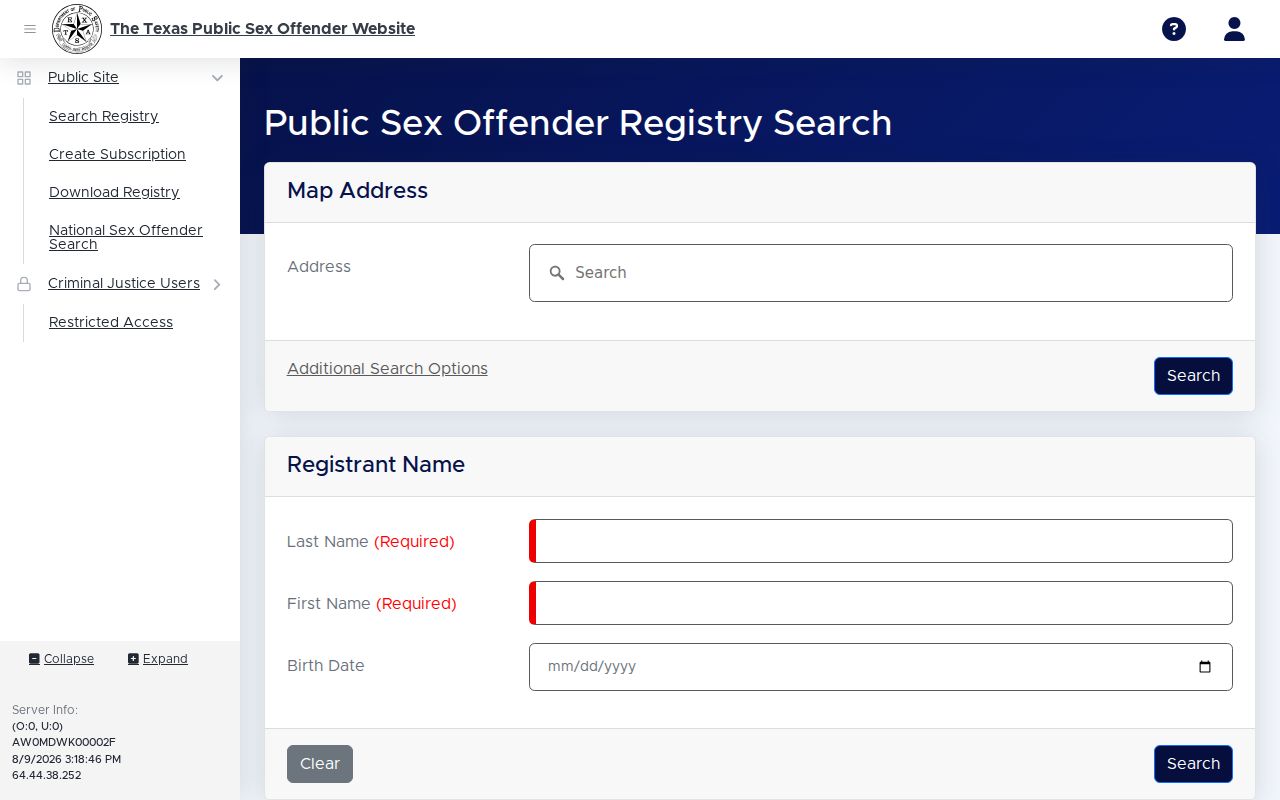
Because Wichita County borders Oklahoma, the national NSOPW search can add cross-state coverage without replacing the official Texas registry.